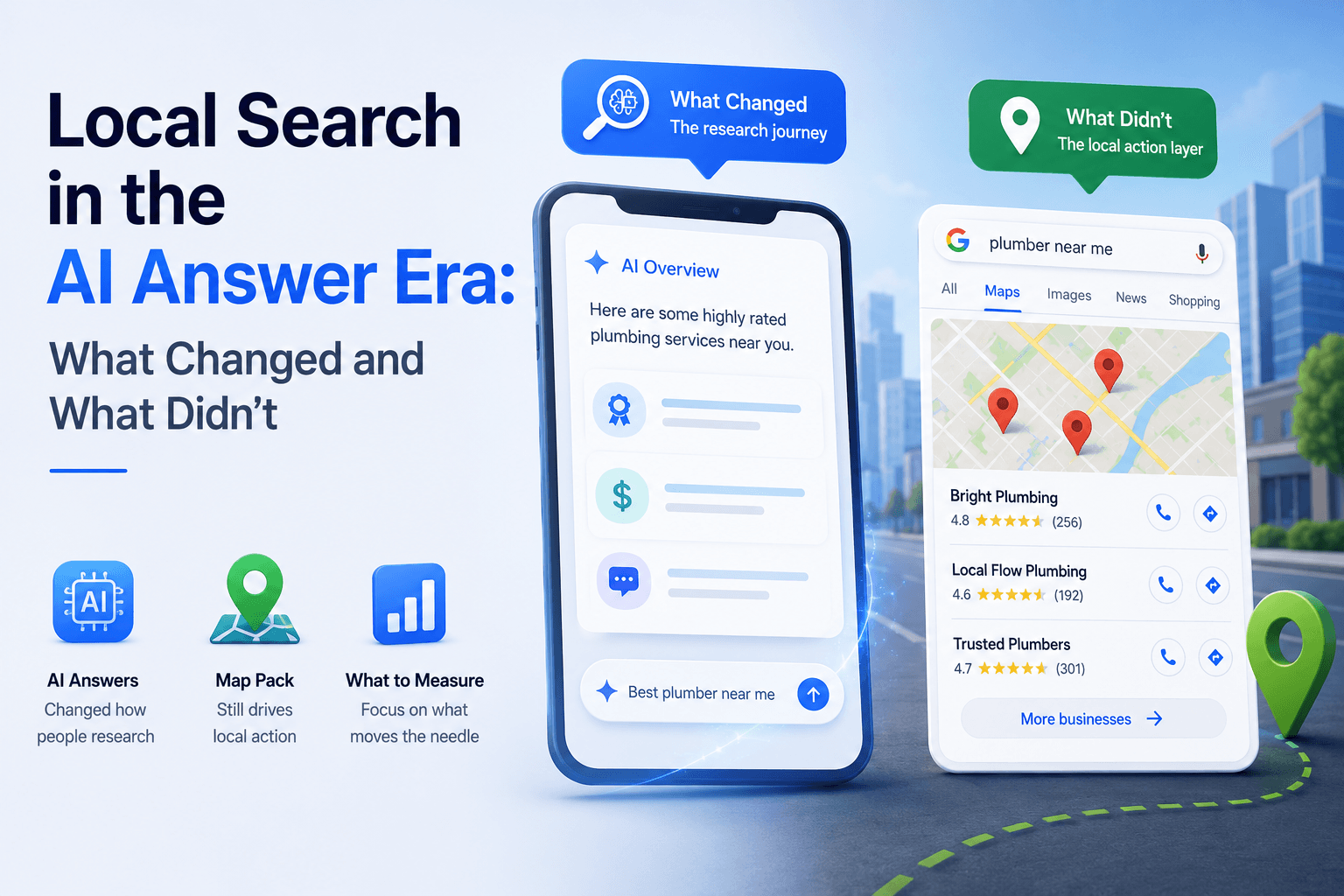
Every few years something arrives that's announced as the end of SEO, and local SEO usually turns out to be the least affected corner of it. AI-generated answers are a genuine shift — but the parts of local search they've changed and the parts they've left alone are not the parts most people assume.
The short version: AI answers have absorbed a lot of the research stage of local intent, and almost none of the transaction stage. That split determines what's worth rethinking.
What genuinely changed
Informational local queries lose clicks. "How much does a bathroom remodel cost in Austin", "do I need a permit for a fence", "what's the difference between a plumber and a gasfitter" — these increasingly get answered in place. If your traffic strategy leaned on informational content pulling people toward a service page, that funnel is narrower than it was.
Research happens before the search you used to see. A customer may arrive at your profile having already narrowed to two or three businesses in a conversation you have no visibility into. The comparison stage moved somewhere you can't measure, which means the signals feeding that comparison — reviews, ratings, what your website plainly states — carry more weight than they did.
Summarised text is now a distribution channel. When a model describes local options, it's drawing on structured, corroborated information about businesses. Being clearly and consistently described across the sources it draws on is roughly the same job as being clearly described for Google's index — which is convenient, because that's work you were already doing.
What didn't change
The map pack still decides transactional local intent. Someone who needs a plumber today still gets a map pack, still picks from three results, and still picks largely on proximity, rating, and review count. That mechanism has been remarkably stable.
Relevance, distance, and prominence still govern it. Nothing about AI answers changes the fact that Google's three stated principles decide who appears, or that distance is measured from a fixed point and can't be optimised away.
The fundamentals still are the fundamentals. Correct primary category, populated services, accurate hours, a steady stream of genuine reviews, consistent data across the web. Every one of those matters at least as much in an AI-mediated result as in a blue-link one, because they're what makes a business describable.
Local visibility is still geographic. Whatever assembles the answer, a result for a nearby service is still computed with reference to where the person is. A single average position told you very little before, and it tells you exactly as little now.
The honest strategic read
If AI systems recommend businesses on the basis of information they can verify and corroborate, then "optimising for AI search" locally reduces to something unglamorous: be the business that is easiest to describe accurately.
That means:
Entity clarity over keyword coverage. One consistent name, address, and phone everywhere; categories that state plainly what the business is; services listed in the words customers use. Ambiguity — three phone numbers, two business names, a category that doesn't match the website — is worse now than it was, because a system generating a summary has to resolve it or omit you. See NAP consistency.
Reviews as source material, not just as a rating. Review text is a rich, current, third-party description of what a business does well. That makes review content — themes, specifics, recency — more valuable than it was when reviews were mostly a star average and a ranking input.
Content that answers rather than ranks. Informational content still earns its place, but the return is increasingly in being the source of an answer and in what it does for people who reach your site, rather than in the click volume it once produced. Thin location pages that existed only to catch a query were already weak; they're now close to worthless.
Website claims that corroborate the profile. If your site says something different from your profile about hours, services, or areas served, you've created a contradiction for anything trying to summarise you.
What this means for measurement
This is the practical part, and it's where a lot of local reporting is about to look silly.
If informational clicks fall while calls and direction requests hold steady, that's not a decline — it's the funnel changing shape. A report that leads with organic sessions will show a crisis that didn't happen. A report that leads with business outcomes — calls, bookings, direction requests, and map pack coverage — will show what actually occurred.
Three things worth watching more closely than before:
- Map pack coverage across your area, since transactional intent still lands there and it's the part AI hasn't taken.
- Profile actions — calls, direction requests, website clicks — as the clearest signal that visibility became a customer.
- Review velocity and themes, because they're feeding both human decisions and machine summaries.
And one thing worth demoting: raw impressions and sessions as a headline. They were always a proxy; they're a noisier one now.
The unexciting conclusion
Very little of this suggests abandoning what works. The businesses positioned best for AI-mediated local search are the ones with accurate profiles, honest categories, consistent data, real reviews, and a website that says the same things as everything else about them — which is the same list as five years ago, with the tolerance for sloppiness reduced.
What does need to change is measurement. Judging local performance on click volume was already shaky, and it's now actively misleading.
Geo-grid rank tracking in SeoNexus measures map pack coverage across your service area rather than a single position, so the part of local search that hasn't moved stays measured properly. GBP performance insights tracks the calls, direction requests, and website clicks that tell you whether visibility is still converting, and review insights surfaces the themes in your review text — the material both customers and summarisers are reading. Citation & NAP audit handles the entity clarity side: one description of your business, everywhere.
To see where you currently stand on all four, the free local check runs in about 20 seconds without an account.