Ask a local business who their competitors are and you'll get the answer they'd give at a trade association dinner: the other established firm across town, the franchise that opened last year, the one whose van they keep seeing.
Ask Google the same question and you get a different list, a different one again two miles north, and a different one for each keyword. The businesses taking your calls are frequently not the ones you think about.
That gap is the whole reason to do competitor analysis properly, and it's why the useful version starts with a search result rather than with a list of names.
Your competitor is per-keyword and per-location
Two things make local competition unlike organic competition.
It changes by query. The three businesses in the pack for “emergency plumber” are often not the three for “water heater installation”. Categories and services differ, so relevance differs.
It changes by where the searcher stands. Proximity is weighted heavily, so the pack rotates as you move across a service area. A business two suburbs away may be your fiercest competitor in the cells nearest them and completely absent from the ones nearest you.
Which means "who are our competitors" has no single answer — but "who beats us for this keyword, in this part of the map" has a precise one, and it's the question that leads to an action.
The practical version: run your core keywords across a grid, find the cells where you're weakest, and look at who occupies the top three there. That's your competitor set. It's usually two or three businesses, not ten, and at least one of them is normally a surprise.
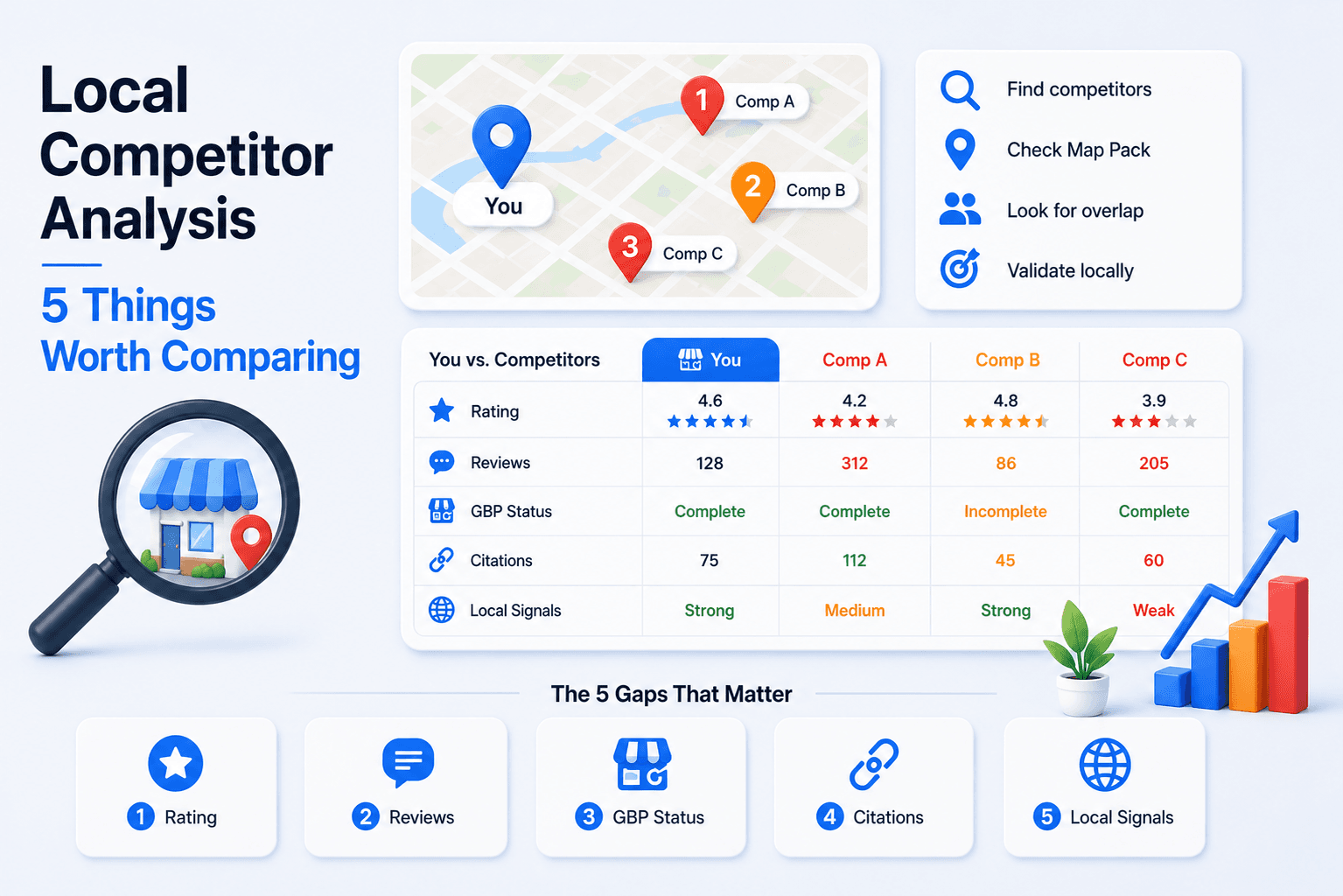
The five things worth comparing
Once you have the right names, most competitive analysis is wasted effort. These five explain the majority of the gap.
1. Primary category. The cheapest and most common finding. If the businesses consistently beating you for a term all use a primary category you don't, that's a relevance mismatch you can often close in an afternoon — provided the category honestly describes you. Never adopt one that doesn't; see choosing categories for where that line sits.
2. Review count, rating, and velocity. Compare all three. A competitor with 400 reviews from four years ago is beatable; one at 120 and adding fifteen a month is pulling away, and the count you see today is the wrong number to plan against. Velocity is the leading indicator.
3. Proximity and address. Sometimes the honest conclusion is that they're closer to the customers in those cells and you're not going to win there. This matters because it's the finding that stops you spending a year on an unwinnable area — and points at the alternative, which is usually a second location or a harder push in the cells you can take.
4. Profile completeness. Services populated, description written, photos current, hours accurate, Q&A answered, posts running. Individually minor; collectively this is the difference between a profile Google can describe confidently and one it can't.
5. Web prominence. Local links, industry directory listings, press, association memberships, and a website that actually explains the service. This is the slowest gap to close and the most durable once closed.
What isn't worth comparing
Their exact keyword density, or anything you'd need a tool to detect and a theory to explain. If a difference requires a hypothesis about the algorithm to matter, treat it as a hypothesis — see what Google confirms versus what studies suggest.
Post frequency as a ranking input. Worth matching for conversion reasons, not because it moves rank.
Their follower counts. Local rankings don't run on social metrics.
Anything you can't ethically replicate. Competitors with keyword-stuffed business names or listings at addresses they don't occupy aren't a strategy to copy — they're a report to file. Copying them is how you end up suspended.
Turning the comparison into a plan
The output of this exercise should be at most three actions, ordered by how fast they move.
Category corrections and profile completeness land in days to weeks. Review velocity takes a quarter to shift the balance and is the highest-leverage sustained investment for most businesses. Prominence work — links, local press, industry directories — is a six-month project and the reason established competitors are hard to dislodge.
If proximity is the whole gap, none of the above changes the result in those cells, and the useful decision is where to spend instead.
Keeping an eye on it
Doing this once produces a snapshot. The reason to repeat it is that the interesting event is usually a change: a new entrant to the top three, a competitor's review count accelerating, a category edit that suddenly makes someone relevant to a term they never appeared for.
Local competitor tracking in SeoNexus identifies competitors per keyword and per grid cell rather than from a list you maintain by hand, puts profiles side by side on the five comparisons above, and tracks up to twenty per location so a new entrant shows up as an alert instead of as a ranking drop you have to explain later. Paired with geo-grid rank tracking, you can see which part of the map each competitor is actually taking from you.
To see who currently holds the top three around your business, the free local check scans your grid and names them, in about 20 seconds and without an account.