Search for “local SEO ranking factors” and you will find hundreds of lists claiming that Google uses dozens—or even hundreds—of signals.
The reality is more nuanced.
Google discloses some broad principles behind local rankings, while SEO studies and practitioners attempt to understand the individual signals that may contribute to those principles.
Knowing the difference matters.
What Google Officially Says
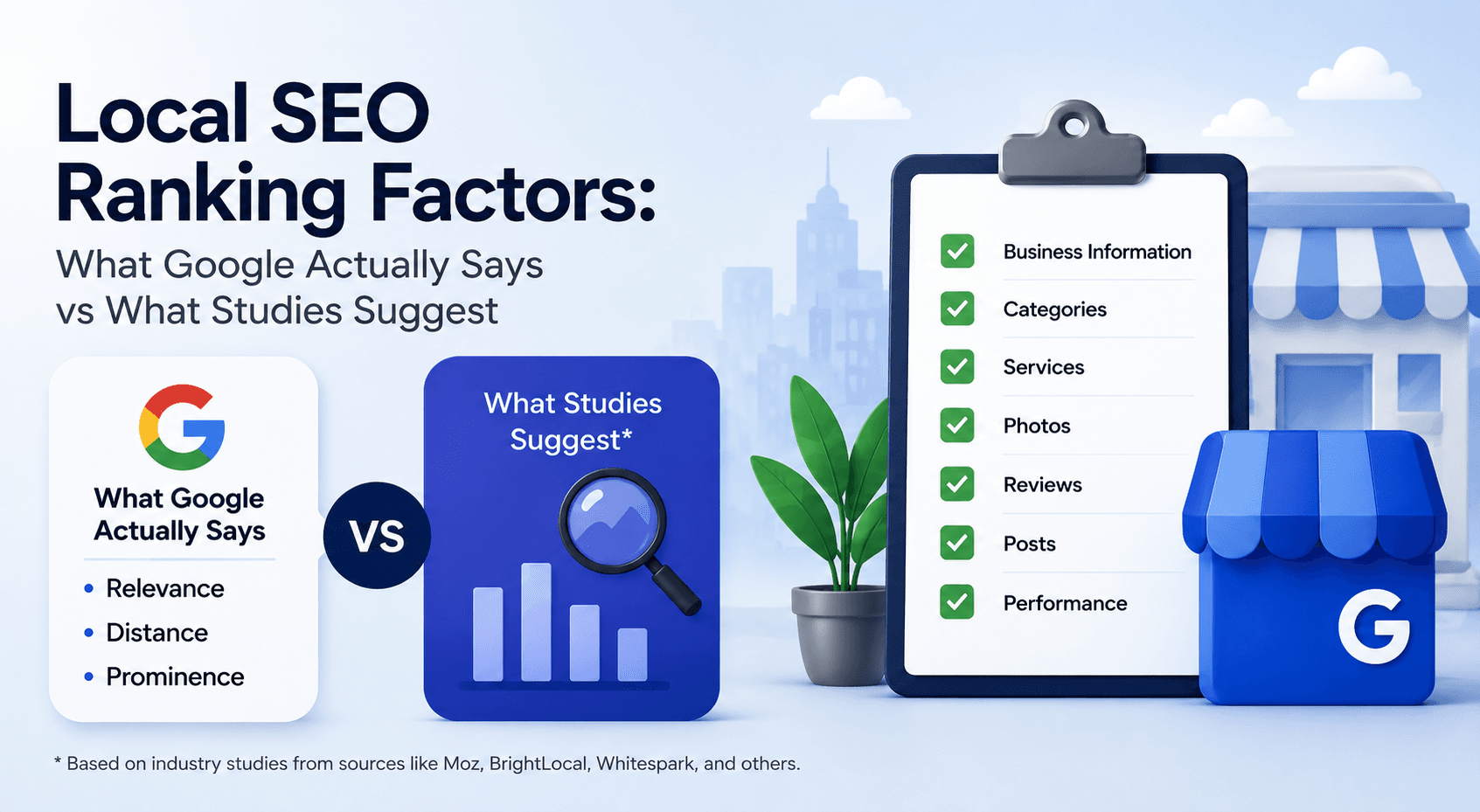
Google says local search results are mainly determined by three factors:
Relevance
Relevance describes how closely a Business Profile matches what someone is searching for.
Choosing appropriate categories, listing relevant services and maintaining accurate information all help establish that context.
Distance
Distance is how far a potential result is from the searcher or the location specified in the query.
This is why local rankings can change significantly across neighborhoods.
Prominence
Prominence reflects how well known a business is.
Google says its understanding of prominence incorporates information from across the web, including links to the business and reviews.
What Local SEO Research Suggests
Google deliberately keeps the details of its ranking algorithms confidential. That leaves local search marketers to learn through experiments, observations and industry surveys.
These findings are useful, but they represent expert observation and testing—not confirmation from Google.
That distinction should always be preserved.
Categories Are Particularly Important
Google does explicitly state that the categories selected for a Business Profile affect local ranking.
Your primary category should specifically describe the core business. Additional categories can describe other genuine aspects of what the business is.
Reviews Are More Than a Ranking Discussion
Reviews also affect whether people actually choose the business.
Businesses should not obsess over whether a particular review changed ranking position from #5 to #4.
Reviews influence both visibility and conversion, making them valuable regardless of their exact algorithmic weighting.
Avoid Ranking-Factor Absolutes
Statements such as:
“Posting every week directly improves rankings.” (Probably not — though posts earn their place for other reasons.)
“Adding photos moves your business three positions.”
“Responding to reviews is a direct ranking factor.”
should be treated cautiously unless backed by credible evidence.
A better approach is to separate signals into three categories:
Google confirmed: relevance, distance, prominence, accurate information, categories, reviews and web prominence.
Strong industry evidence: observations repeatedly identified through testing and practitioner research.
Hypotheses: correlations that may be useful to test but are not proven.
Local SEO becomes far more effective when you stop chasing myths and instead build around what Google clearly wants: a business that is relevant, geographically appropriate, prominent, trustworthy and accurately represented online.
Test the Hypotheses Instead of Believing Them
The only way to move a claim from "hypothesis" to "strong evidence" for your market is to measure before and after you change something.
That is easier with a baseline you did not have to assemble by hand. Geo-grid rank tracking in SeoNexus keeps grid history, so a category edit or a review campaign has a clean before-and-after picture rather than a recollection. Local competitor tracking shows which businesses actually occupy the top three in each cell, and what their categories and review profiles look like — which is usually a faster answer than any ranking-factor list.
Want a baseline before you change anything? The free local check runs one scan and shows you the current shape.