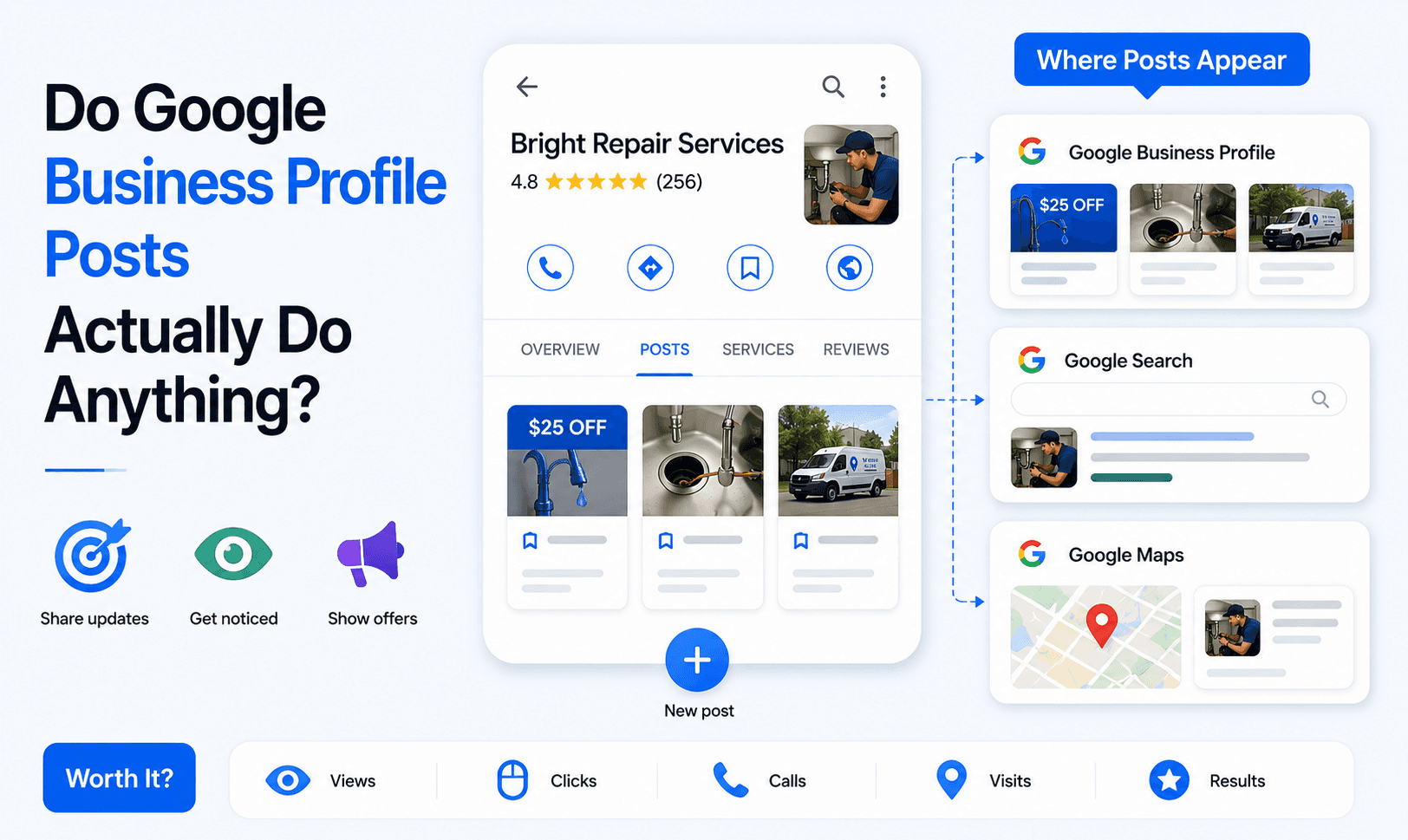
"Post weekly to your Google Business Profile" appears on nearly every local SEO checklist, usually with an implied promise that it moves rankings.
Google has never confirmed that it does, and the evidence for it is the kind of correlation you'd expect from the fact that businesses which post regularly tend to be businesses that maintain everything else too. Treating it as a confirmed ranking factor puts it in the wrong category — see what Google says versus what studies suggest.
That's not an argument for skipping posts. It's an argument for being honest about why you're doing them, because the honest reasons change what you post.
What posts demonstrably do
They occupy space on your profile. A customer comparing three businesses in the pack sees one with a current offer and two without. That's a conversion difference, and conversion is the point at which local SEO turns into revenue.
They answer objections at the moment of decision. Holiday hours, "we're still taking bookings this week", a new service, financing available, a seasonal promotion. This is information a customer needs before they call, and the profile is where they are.
They signal an active business. A profile whose most recent activity is eighteen months old reads as possibly closed — to customers, whatever it does or doesn't do algorithmically.
They're indexable content you control, in a place where you otherwise have very little control over presentation.
None of that requires a ranking claim to justify. All of it disappears if you post filler.
Where posts actually show up
Worth knowing before you invest, because visibility is more limited than most people assume.
Posts appear most prominently on the full profile view — the panel someone sees after clicking through from the pack, or the Maps listing view. They're much less prominent for someone who only ever sees the three-result pack, which is a large share of local searches.
The practical read: posts work on customers who are already evaluating you specifically. They're a conversion tool for people in consideration, not a discovery tool for people who haven't found you. That's a perfectly good job — it's just a different one from ranking.
The post types, and what each is for
Updates are the general-purpose type: news, seasonal information, a service you want to highlight. These expire from the prominent position after roughly a week, which is where the "post weekly" advice comes from — it's a display cadence, not an algorithmic one.
Offers carry a date range and a redemption detail, and they're the type with the clearest commercial case. If you run promotions at all, they belong here.
Events have start and end dates and are genuinely useful for businesses that run them — classes, open days, clinics, tastings. Ignore this type if you don't.
The single most common mistake is posting Updates that are really just filler — a stock photo and a sentence about it being Tuesday. That takes real time and produces nothing. Fewer, more substantial posts beat a weekly quota met with noise.
What to post if you're going to bother
A workable rotation for most businesses, roughly monthly rather than weekly:
- The offer or promotion currently running, if any
- The service you most want more of, described in customer language
- Anything time-sensitive: holiday hours, seasonal availability, closures
- A genuine piece of proof — completed work, an award, a new certification
- Answers to the questions your phone staff repeat every day
That last one is the most underused. If three callers a week ask whether you handle emergencies on weekends, that's a post, and it's worth more than a quarter of stock imagery.
Keep the call to action concrete — call, book, get directions — and don't keyword-stuff the body. Nobody has shown that helps, and it reads badly to the customer who's deciding.
How to tell whether it's working
Not by watching rankings. If posts primarily affect the behaviour of people already looking at your profile, then rank is the wrong instrument and you'll read noise as signal.
The right measurements are the profile actions: calls, website clicks, direction requests, and booking clicks, trended against when you posted. If a month of substantive posts moves calls and a month of filler doesn't, that's your answer, and it's specific to your business rather than borrowed from someone's case study.
For offers specifically, track redemptions if you can. A promotion with a code tells you more in one month than a year of engagement metrics.
Making it sustainable
The reason posts lapse isn't disagreement about their value. It's that "someone logs into the profile every week" is a fragile process, and it's the first thing dropped in a busy month — across ten locations it was never realistic to begin with.
GBP posts & offers in SeoNexus lets you write and schedule posts ahead across one profile or all of them, so the cadence survives a busy quarter and multi-location brands can push a consistent offer without ten people logging in separately. GBP performance insights supplies the measurement side — calls, website clicks, and direction requests trended over time, which is where you'd actually see a post's effect if it has one.
If you want to know whether your profile currently looks active or abandoned, the free local check grades profile completeness and recency in about 20 seconds, without an account.