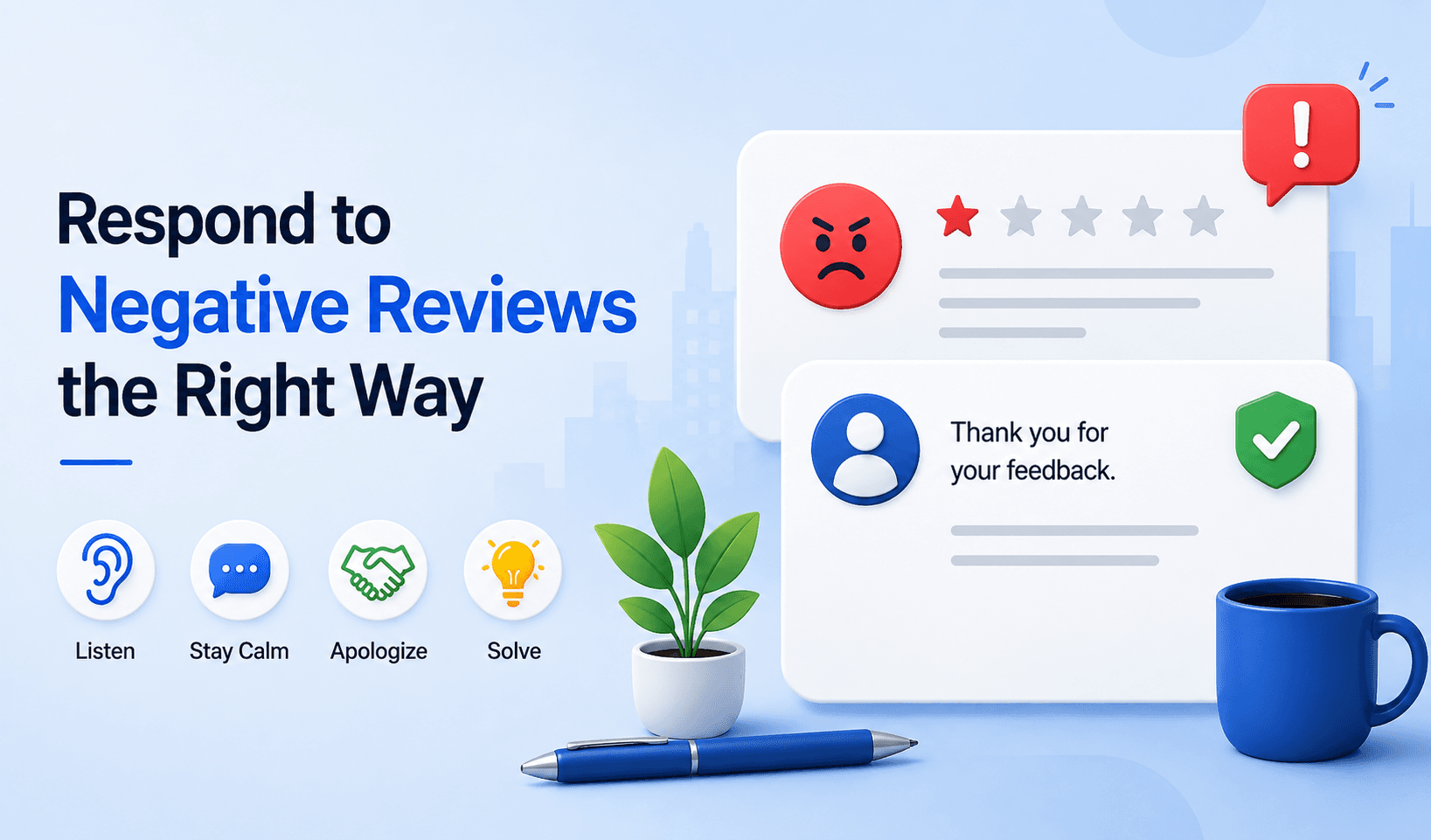
The reply to a negative review is not written for the person who left it. They have already had the experience and formed their opinion. It's written for the next several hundred people who read that review while deciding whether to call you — and for whom your reply is the only evidence of how you handle problems.
That reframing solves most of the hard questions. You're not trying to win. You are trying to show a stranger what happens when something goes wrong.
The structure that works
Four parts, in this order, in under 100 words.
1. Thank them and name the problem. Specifically — "sorry you had a bad experience" reads as a form letter. "Thank you for flagging the 40-minute wait on Saturday" reads as someone who actually got the message.
2. Take responsibility for your part. Not necessarily all of it. "That's longer than anyone should wait" is true and costs nothing, even when the delay had a cause.
3. Say what changed. This is the part almost everyone skips, and it's the part that convinces readers. "We've added a second technician on weekends" is worth more than three sentences of apology.
4. Move it offline. Give a name, a direct line or email, and an invitation. Then stop. Do not resolve the dispute in public.
Before and after
Review (2★): Waited 40 minutes past my appointment time and nobody told me anything. Second time this has happened.
A reply that makes it worse:
We're sorry you feel this way. Saturdays are our busiest day and we do our best. If you had asked at the desk, someone would have given you an update. We hope you'll give us another chance.
Three mistakes: "sorry you feel this way" disputes the experience, the blame lands on the customer for not asking, and nothing changed.
A reply that helps:
Thanks for telling us, Dana — a 40-minute wait with no update isn't acceptable, especially twice. We've since added a front-desk check-in at the 15-minute mark so nobody sits without hearing from us. I'd like to make Saturday right: I'm at maria@…, or ask for Maria at the desk.
Same facts. Completely different signal to the next reader.
The things that never work
- "Sorry you feel that way." It's a denial with a polite face, and readers hear it as one.
- Arguing the facts. Even when you're right, a public factual rebuttal reads as defensive. The audience can't verify who's correct — they can only see who is calmer.
- Mentioning anything private. Naming an account, a treatment, a case, or an order in a reply can break confidentiality rules in regulated industries and looks bad in every other one.
- A copy-pasted paragraph. Readers scan three or four replies at once. If they're identical, the whole review section becomes noise.
- Asking them to take it down. In public, this always reads badly. Fix the problem and some people remove it themselves.
How fast
Within 48 hours. Speed is a stronger signal than polish, and reply rate correlates with map-pack visibility — Google's own guidance treats responding to reviews as part of maintaining an active profile.
The failure mode is a business that replies to everything for three months and then stops, leaving the recent reviews — the ones people actually read — unanswered. A consistent 48-hour habit beats a burst.
If keeping up is the constraint, AI-drafted replies trained on your own tone get you a first draft in seconds. Edit before publishing; the draft is a starting point, not a send button.
When not to reply
Two cases.
The review is fake or violates policy. Reviews from competitors, from people who were never customers, or containing slurs or personal attacks should be reported for removal, not answered. Answering a fake review lends it standing. Report it, wait, and reply only if it survives.
Replying would disclose something you shouldn't. In healthcare, law, and finance, confirming that someone is a client is itself a disclosure. Use a neutral line that acknowledges nothing: "We take all feedback seriously and would like to discuss this directly — please contact our office at […]." Your compliance team likely has an approved version; use theirs.
The part that isn't about replies
If the same complaint appears four times, the reply is not the fix. Running sentiment analysis across your review history usually surfaces one or two recurring operational issues, and fixing one of them does more for your rating than a year of well-written responses.
Reviews are a measurement instrument. It's worth reading them that way before writing back.
Want to see where your review profile stands right now? The free local check reports your rating, review velocity, and unreplied count alongside your map rankings.