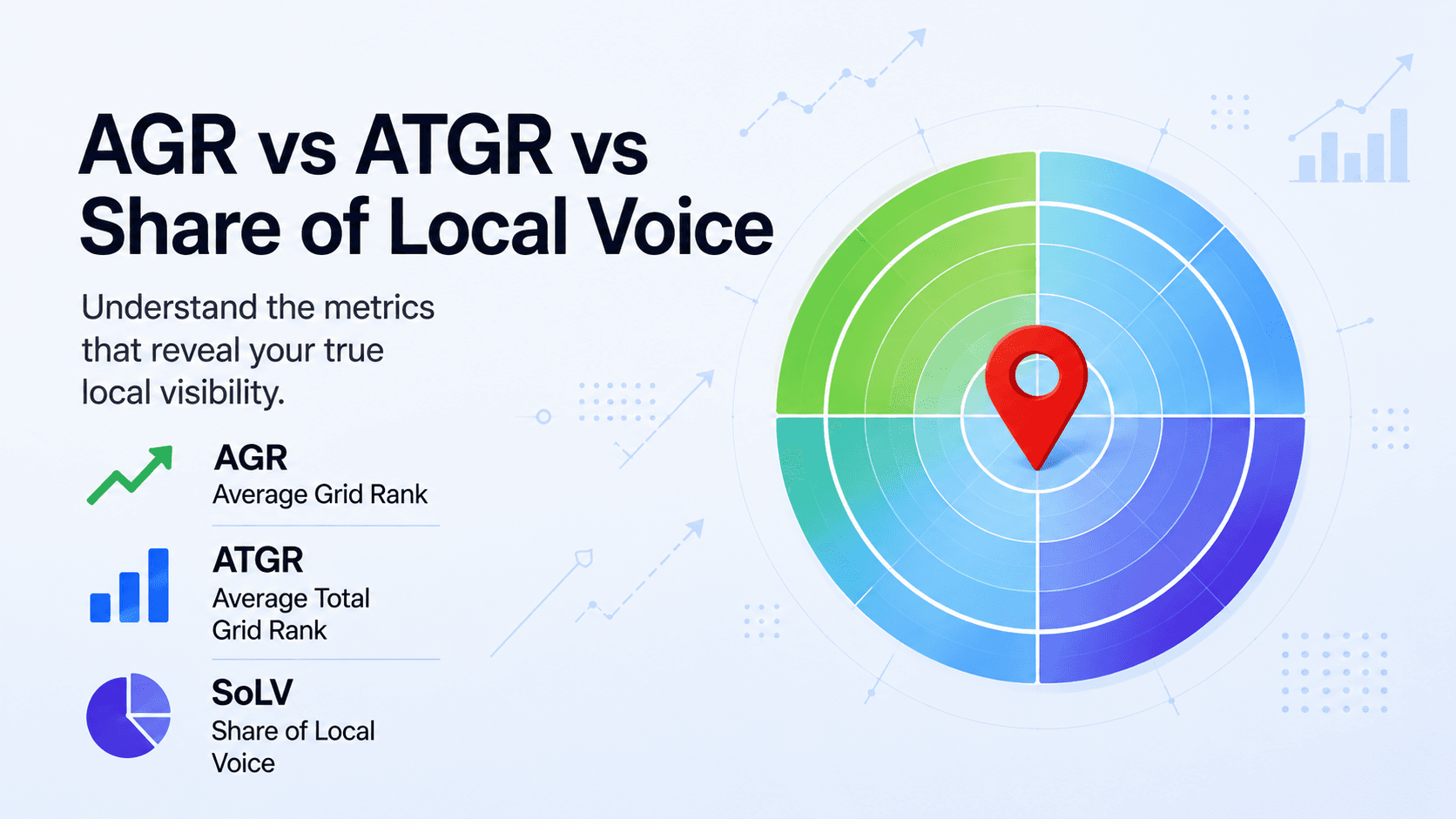
Geo-grid rank tracking gives local businesses something traditional rank trackers cannot: visibility across an entire geographic area.
But a grid of 25 or 49 ranking numbers can quickly become difficult to interpret.
Metrics such as AGR, ATGR and Share of Local Voice help summarize what is happening.
AGR: Average Grid Rank
AGR stands for Average Grid Rank.
It answers:
How well do I rank across the grid cells where my business is visible?
AGR is useful for understanding ranking strength, but it should not be used alone because it can hide areas where the business does not rank at all.
ATGR: Average Total Grid Rank
SeoNexus uses ATGR to mean Average Total Grid Rank.
Unlike AGR, ATGR accounts for cells where the business does not appear within the tracked ranking range.
This produces a more realistic measure of total geographic performance.
AGR might make a business appear strong because it ranks well in a few cells.
ATGR exposes the dead zones.
SoLV: Share of Local Voice
Share of Local Voice asks:
In what percentage of grid cells do we appear in the top three Maps results?
For example, imagine a 5×5 grid containing 25 search points.
If your business ranks in the top three at 15 points:
SoLV = 60%.
Why top three?
Because Map Pack visibility is commercially important.
Which Metric Matters Most?
There is no single winner.
Use them together.
AGR falling: Your positions are improving where you already rank.
ATGR falling: Your total geographic visibility is improving, including weaker areas.
SoLV increasing: You are occupying the most visible Maps positions across more of your territory.
A campaign could improve AGR without meaningfully expanding geographic reach.
Another campaign might initially improve ATGR by turning previously invisible cells into positions #12–#15 before those cells eventually reach the top three.
Measure Trends, Not Isolated Numbers
The real power comes from comparing the metrics over time:
- Before optimization
- After category or profile changes
- After website improvements
- After a review campaign
- After several months of local SEO
Geo-grid metrics transform Maps visibility from an anecdote—“I searched and saw us at #2”—into measurable geographic performance.
AGR tells you how strongly you rank.
ATGR tells you how completely you rank.
SoLV tells you how much of the Map Pack territory you own.
Tracking These Over Time
Calculating AGR, ATGR and SoLV once is arithmetic. Keeping them comparable across months — same keywords, same grid size, same coordinates — is the part that usually breaks when it's done manually.
Geo-grid rank tracking in SeoNexus computes all three from every scheduled scan and stores the grid behind them, so you can put a before-and-after heatmap next to the numbers rather than asking a client to trust an average. When SoLV drops in one part of the map, local competitor tracking tells you who took those cells.
Curious what your current SoLV is? The free local check runs a scan and reports it, without an account.